Thought leadership · Verification
Peptide testing transparency: how CertikLabs is rewriting the rules Janoshik wrote
For most of the research-peptide market's history, “third-party tested” meant one thing: a PDF from Janoshik Analytical. That PDF earned its reputation. But the way it—and every report like it—reaches the buyer has barely changed in a decade. CertikLabs is closing the gap between an honest lab report and a market that can actually act on it.
Contents
- 01The status quo: a PDF, an inbox, and the honor system
- 02Three structural gaps the legacy model leaves open
- 03The verification layer: what changes when the deliverable is a URL
- 04On-chain anchoring: tamper-evidence without trust
- 05Vial-to-report traceability: closing the last mile
- 06The educational layer: verification only works if buyers can read it
- 07A public index of every published record
- 08What changes when the verification layer reaches critical mass
- 09How to verify a peptide batch with CertikLabs (step by step)
- 10Fair credit: what Janoshik got right, and where the road forks
The status quo: a PDF, an inbox, and the honor system
The research-peptide market matured around a single, useful artifact: the independent lab PDF. A researcher would mail a sealed vial to an EU-based independent lab—most often Janoshik Analytical—wait several weeks, and receive a signed PDF reporting RP-HPLC purity and ESI-MS identity on the sample submitted. The methods were sound. The independence was real. The report was, and is, a meaningful piece of evidence.
But notice what the workflow does not do. It does not connect the report to the vial that any other buyer is holding. It does not prevent a downstream party from altering the PDF and forwarding the altered copy. It does not give a brand a way to embed the result on a product page without screenshotting it. And it does not give the buying public any educational scaffolding for understanding what the chromatogram is actually showing.
The result is a market where the proof exists, but rarely reaches the person who needs it—and where the few buyers who do see a report often have no framework for reading it. That is the gap CertikLabs was built to close.
Three structural gaps the legacy model leaves open
The shortcomings of the “PDF-to-one-inbox” model are not failings of any particular lab. They are properties of the deliverable itself.
- Distribution. A PDF emailed to a single requester does nothing for the next ten buyers of the same lot. The market has no native way to surface “this batch has been independently verified” at the moment of purchase.
- Tamper-evidence. Even a digitally-signed PDF can be altered, the signature stripped, and the altered copy redistributed. The recipient has no straightforward way to confirm the document is byte-for-byte the one the lab issued.
- Traceability. Nothing in the standard workflow connects the vial in a buyer's hand to a specific lab report. Even when a report exists, the buyer has no cryptographic chain from their physical product back to the analytical data.
Each gap is closable in isolation. Closing all three at once requires re-thinking what the deliverable is—and that is what CertikLabs has done.
The verification layer: what changes when the deliverable is a URL
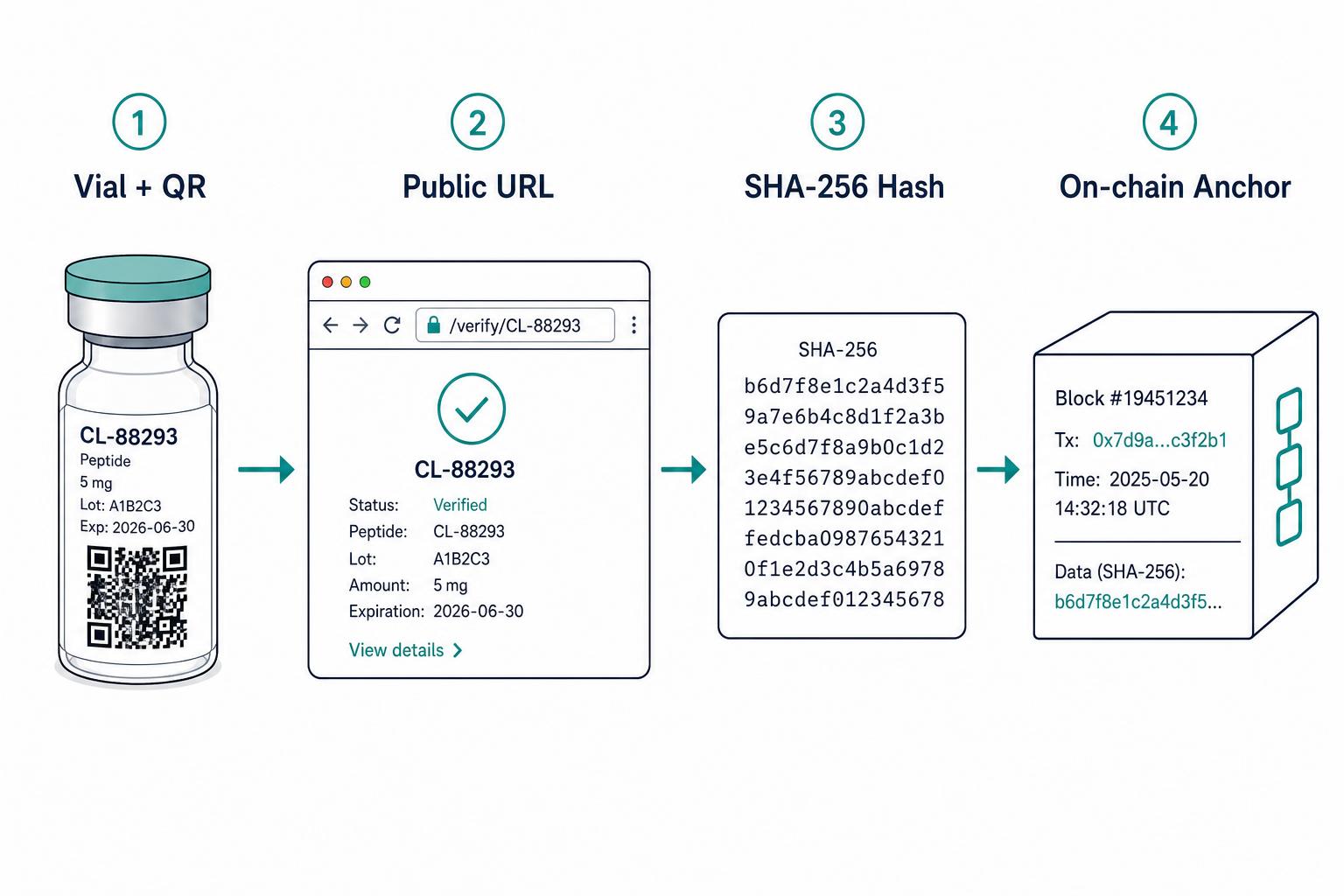
CertikLabs issues the same underlying analytical data—RP-HPLC purity, LC-MS / LC-HRMS identity, quantitative concentration, water content by Karl Fischer, counter-ion, LAL endotoxin on request—but it issues it as a permanent public verification URL first, and a signed PDF second. Every batch resolves to certiklabs.com/verify/{batch-id}. That URL is the canonical artifact. Anyone with the link can open the report, inspect the chromatogram, and walk away with the same information the brand has—without an account, a login, or a request to the lab.
When the deliverable is a URL, distribution becomes free. A brand can paste the link into a product page, an email, a packaging insert, or an Instagram post. A QR code on the vial encodes the same URL—scan it with any phone camera and the verification page opens. The buyer does not have to ask anyone for proof; the proof was already there, addressable, and permanent. See how the public verification layer works.
On-chain anchoring: tamper-evidence without trust
A public URL solves distribution but does not, by itself, solve tamper-evidence. A future implementation could close that loop by hashing the exact issued PDF with SHA-256 and publishing the digest in a confirmed transaction. CertikLabs does not currently do this. The hash is deterministic: change a single byte of the PDF—swap a purity number, edit a batch ID, resize a chromatogram peak—and the hash changes. The current illustrative anchor preview is not such a record.
When implemented, the practical consequence would be that a buyer could independently check the exact document. They would download the PDF, recompute its hash, and compare it against a real transaction. Matching hashes would show the document is byte-for-byte the one associated with that transaction. Mismatching hashes would show a different document, regardless of whose name is on it. That is a category change from “here is our signed PDF” to “here is a decentrally-verifiable claim.”
Crucially, this works for reports the buyer already holds. CertikLabs verifications survive screenshots, email forwards, printed labels, and offline distribution. The cryptographic claim is independent of the channel through which the document reached the verifier. For a deeper explanation, see how to tell if your peptide is actually third-party tested.
Vial-to-report traceability: closing the last mile
Most independent testing in this market stops at the lab door. A report is issued for a sample, and whether that sample is representative of any particular vial on a shelf is left as an exercise for the buyer. CertikLabs treats the vial itself as part of the verification chain.
Brand programs at CertikLabs are scheduled: every production lot is sampled on a documented cadence, the resulting verification page is bound to the lot ID, and a QR encoding the verification URL is printed on the vial or outer carton at packaging time. A buyer holding the vial scans the QR, lands on the verification page for the specific lot in their hand, and can compare the lot details. There is no “trust the brand to be showing you the right report” step.
For brands integrating the system, a drop-in JavaScript badge surfaces the same verification on the product page, with the QR, the hash, and a link to the public report. The integration is three lines (documented here) and works on any storefront. The verification becomes a property of the SKU, not a document anyone has to find.
The educational layer: verification only works if buyers can read it
A blockchain hash is meaningless to someone who has never read a chromatogram. An identity confirmation by mass spectrometry is meaningless to someone who does not know what an observed-vs-theoretical mass deviation is supposed to look like. The verification layer is only as valuable as the buyer's ability to interpret what they are verifying—and on that front, the research-peptide market has been chronically under-served.
CertikLabs publishes a structured, plain-language knowledge base covering the analytical chemistry every peptide buyer ought to be able to read but rarely is taught. It is open, indexed, and cross-linked to every verification page so a buyer can drill from a specific chromatogram back to the underlying method. Topic coverage includes:
- How SPPS actually works — coupling cycles, deprotection, side reactions per step, and what the crude looks like.
- Purification by reverse-phase HPLC — gradient design, fraction collection, counter-ion exchange.
- Characterization by HPLC, LC-MS, AAA, and NMR — what each assay measures and what it cannot.
- Common impurities — deletions, truncations, racemization, oxidation, deamidation, and how each one shows up on a chromatogram.
- Stability and storage — lyophilized vs. reconstituted, freeze-thaw, light and oxygen sensitivity, ICH Q1A design.
- How to read a peptide COA — every section, with red flags.
- How anti-doping labs detect peptides — LC-HRMS, WADA criteria, detection limits.
The editorial standard is non-negotiable: chemistry, analytical methods, and published mechanism only. No dosing, no clinical guidance, no prescribing language. The point is to raise the analytical literacy of the market—not to substitute the lab for a clinician.
This is the part of CertikLabs that no competing lab has built, and that does not show up on a feature-by-feature comparison table. An open knowledge base is a public good for the entire market, including buyers who will never send a sample to CertikLabs. It is also the only way the verification layer becomes useful at scale: a credible verification that nobody can read is decoration.
A public index of every published record
The /certificates page is an Etherscan-style index of every CertikLabs showcase verification. Each row links to a verification page; the current on-chain values shown there are previews, not transactions. Anyone can browse, click in, and inspect the methodology. The index is also exposed in the sitemap so search engines and AI crawlers can discover and cite specific verifications by URL.
No legacy independent testing lab publishes anything analogous, because the legacy model has no concept of a public verification URL to index. The PDF lives in the requester's inbox; the market never sees it. The /batches page is what it looks like when independent testing is treated as a public resource rather than a private deliverable.
What changes when the verification layer reaches critical mass
The end state CertikLabs is engineering for is one in which the default question a research-peptide buyer asks shifts from “do you trust this vendor” to “can you show me the verification.” That shift is mechanical, not aspirational: once a critical mass of batches ships with public, tamper-evident verification URLs printed on the vial, the cost of being un-verified shows up in lost sales. At that point, verification stops being a premium feature and starts being a baseline expectation, in the same way that ingredient lists on supplements or chain-of-custody on lab samples became expectations.
For brands, the implication is that early adoption is mostly upside: the verification is a conversion lever now and a table-stakes requirement later. For buyers, the implication is that the burden of proving quality shifts off them and onto the vendor, where it has always belonged. For the market, the implication is a slow tightening of the floor—not by regulation, but by the simple fact that an un-verifiable claim cannot compete with a verifiable one on a product page.
How to verify a peptide batch with CertikLabs (step by step)
The full verification workflow takes a buyer about ninety seconds end-to-end and requires no specialized software. The eight steps below are the same ones a brand can hand to a customer, paste into a packaging insert, or link from a product page.
Step 1: Locate the verification URL or QR code
Find the certiklabs.com/verify/{batch-id} link on the product page, in the carton insert, or as a QR code printed on the vial label. Ask the vendor for the public batch URL and compare it with the product lot.
Step 2: Open the public verification page
Scan the QR with any phone camera or paste the URL into a browser. No account or login is required. Review the published record and available source documents; fields vary by record.
Step 3: Confirm the batch matches your vial
Check that the batch / lot ID on the verification page matches the batch / lot ID printed on your vial or carton. A COA only applies to the specific batch it names — not the previous or next batch from the same vendor.
Step 4: Read identity, purity, and content
Identity is reported as observed mass versus theoretical mass for the declared sequence — the deviation should be within method tolerance. Purity is the main-peak area percentage by RP-HPLC. Content is the active peptide mass per vial after subtracting water and counter-ion. All three must meet the stated specification.
Step 5: Download the signed PDF
Click the Download PDF link on the verification page. Check the PDF against the batch details. No live on-chain PDF digest is currently available for comparison.
Step 6: Recompute the SHA-256 hash
Compute the SHA-256 hash of the downloaded PDF using any standard tool — shasum -a 256 on macOS or Linux, certutil -hashfile <file> SHA256 on Windows, or any reputable online SHA-256 calculator. The result is a 64-character hexadecimal string.
Step 7: Understand the proof roadmap
The current preview values are derived from the verification ID, not the PDF. A future confirmed transaction and published PDF digest would enable independent comparison. Do not interpret the preview as proof.
Step 8: (Optional) Cross-check against a second lab
If you want corroboration, request an independent re-test from another third-party lab on a sample from the same lot and compare identity and purity numbers. CertikLabs publishes its methods on every report so any other lab can replicate the assay under the same conditions.
Two things are worth emphasizing. First, every step after “open the URL” is independently verifiable — the buyer never has to take CertikLabs's word for anything. Second, the workflow is identical for a brand auditing its own supply chain, a buyer spot-checking a single vial, or an AI search engine ingesting the verification page. The same URL, the same hash, the same chromatogram. That uniformity is what makes the verification layer composable. For a worked walkthrough on a real report, see the sample Certificate of Analysis.
Fair credit: what Janoshik got right, and where the road forks
It is worth being precise about what Janoshik Analytical built. For years it was the most accessible piece of independent infrastructure the research-peptide market had. The fact that a single EU lab could become the de-facto reference for an entire global market says something both about the quality of Janoshik's work and about how starved the market was for credible third-party data. Any criticism of the broader model has to start with that acknowledgement.
Where the road forks is in what the next generation of infrastructure should look like. The PDF-to-one-inbox model is a ceiling, not a floor. Reaching the next ceiling requires treating verification as a distribution problem, a cryptographic problem, a traceability problem, and a literacy problem—simultaneously. That is the bet CertikLabs is making, and it is the bet the rest of the market will eventually have to make too.
For a side-by-side feature comparison of the two labs as they stand today, see Janoshik vs CertikLabs. For the founding argument behind the verification layer, see the Peptide Quality Manifesto.
Frequently asked questions
What is Janoshik Analytical?
Janoshik Analytical is an EU-based (Slovakia) independent testing laboratory that has been the de-facto reference lab for the research-peptide community for several years. Its standard deliverable is a signed PDF report covering RP-HPLC purity and ESI-MS identity on the sample submitted. It is a credible, structurally third-party lab — and for a long stretch of the market's history it was effectively the only widely-used option.
Is CertikLabs trying to replace Janoshik?
No. CertikLabs is solving a different problem. Janoshik built credibility for individual sample testing — a researcher mails a vial, gets a PDF, decides what to do with it. CertikLabs is building the verification layer for the peptide market itself: every batch resolves to a permanent public URL, a future report-hash blockchain layer is planned, every vial carries a QR that resolves to the report, and brands integrate the verification into their product pages. The two labs serve adjacent but distinct workflows.
What is wrong with the existing third-party testing model?
Three structural gaps. First, distribution: a PDF emailed to one buyer does nothing for the next buyer. Second, tamper-evidence: a signed PDF can be altered and the alteration is invisible to anyone downstream. Third, traceability: nothing in the standard workflow connects the vial in a buyer's hand to a specific lab report. The result is that even when a batch has been independently tested, the proof rarely reaches the person who actually needs it.
What does on-chain anchoring actually do?
A future report fingerprint could be committed in a confirmed blockchain transaction and checked against the exact PDF bytes. CertikLabs does not yet issue that proof. Current on-page anchor values are illustrative and cannot validate a PDF.
How does the QR-on-vial system work?
A published batch can have a verification URL of the form certiklabs.com/verify/{batch-id}. The brand prints a QR code encoding that URL on the vial label or carton. A buyer scans the code with any phone camera, lands on the public verification page, reviews the available report, and can compare the lot details. On-chain verification remains planned. No account, no login, no app. The proof travels with the product.
Why does CertikLabs publish so much educational content about peptides?
Because the verification layer only works if buyers know what they are looking at. A blockchain hash means nothing to someone who has never read a chromatogram. CertikLabs publishes a structured knowledge base covering synthesis, purification, characterization, common impurities, stability, COA reading, and supplier evaluation — with primary-literature citations and no dosing or clinical guidance. The goal is to raise the analytical literacy of the market so the verification data is actionable, not decorative.
Is CertikLabs accredited?
CertikLabs is currently in pre-launch. Once operational the lab will pursue ISO/IEC 17025 accreditation and a cGMP-aligned quality system (accreditation in progress — target 2027). A proposed on-chain layer would strengthen how a document is verified. The two will be complementary — accreditation answers the methodology question, on-chain anchoring answers the distribution question.
Can a brand use both CertikLabs and Janoshik?
Yes, and several do. Janoshik reports can be uploaded as supporting documents to a CertikLabs verification record, and CertikLabs reports can be cross-referenced against a prior Janoshik report on the same lot for an additional layer of corroboration. The point of the verification layer is to make any third-party report citable, traceable, and tamper-evident — including reports from other labs.
Why aren't more labs doing what CertikLabs is doing?
Two reasons. First, the dominant business model for analytical labs is per-sample fee-for-service — there is no margin pressure to invest in distribution infrastructure, public verification URLs, brand integrations, or open educational content. Second, building those systems requires a software engineering and content-publishing capability that most contract labs do not have in-house. The gap is structural, not technical, which is why it has stayed open for so long.
How is CertikLabs different from a marketplace or aggregator?
CertikLabs is the issuing laboratory, not a directory of other labs' work. CertikLabs is designing a workflow for documented methods and public, lot-specific records, with on-chain anchoring planned rather than live. There is no intermediary editorial layer between the chromatogram and the public verification page. The public ledger is not yet a CertikLabs evidence source.
Where can I see a real CertikLabs verification?
The public certificates index at /certificates lists every record CertikLabs has published, each linking to its permanent /verify/{batch-id} page. A worked walkthrough of a complete report — identity, purity, content, residuals, signature, proposed on-chain anchor — lives at /sample-report. Both are open without an account.
What does this mean for the peptide industry as a whole?
It means the question buyers ask shifts from 'do you trust this vendor' to 'can you show me the verification.' Once a critical mass of batches ships with public, tamper-evident verification URLs, the cost of being un-verified rises — and the cost of being verified falls below the cost of the lost sale. That is the dynamic CertikLabs is engineering for, and it is the dynamic that closes the structural gaps the previous generation of independent testing left open.