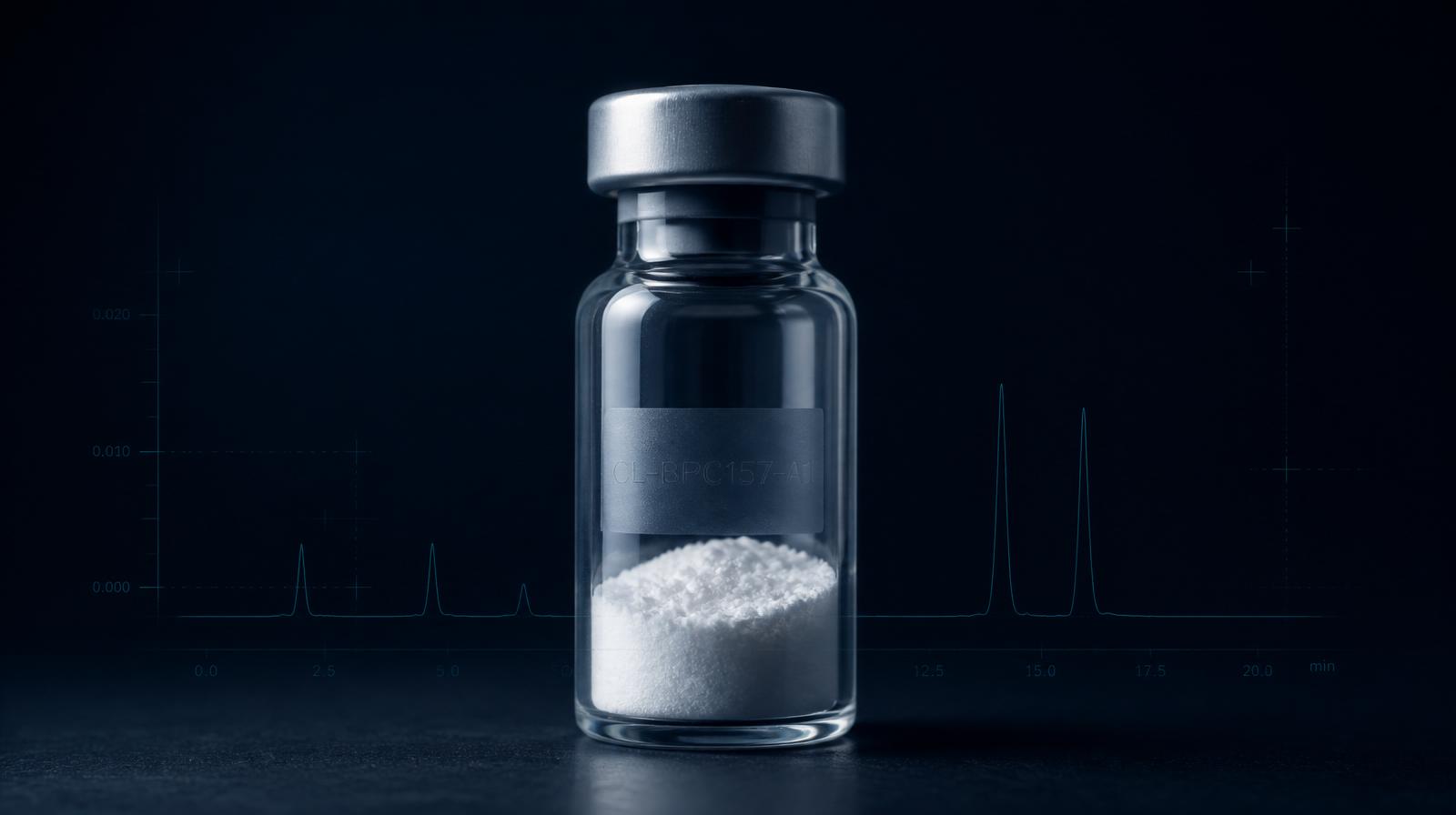
Reference vial CL-BPC157-A1 — composited with the analytical chromatogram returned at release
Pricing guide · BPC-157
BPC-157 testing cost: what a complete third-party verification actually pays for
A complete third-party verification of a BPC-157 batch is not one test — it is a panel of independent assays that together answer a different question than purity alone. This guide breaks down what each assay costs, what it actually measures, and which combination is appropriate for which buyer.
Contents
- 01The short answer
- 02Itemized cost table
- 03HPLC purity — the cheapest credible test
- 04LC-MS identity — the test that proves it is BPC-157
- 05Content by amino-acid analysis — the test most often skipped
- 06Recommended panels by use case
- 07What you actually receive for the price
- 08Why prices vary between labs
- 09Get a BPC-157 batch verified
- 10Frequently asked questions about BPC-157 testing cost
The short answer
A single-batch HPLC purity test on BPC-157 starts around $249. A complete characterization panel — HPLC purity, LC-MS identity, and content by amino-acid analysis — runs $549 to $749 per batch. Adding bacterial endotoxin (LAL) brings it to roughly $749 to $949. Sterility testing, where applicable, adds another $200 to $350.
Below we break down what each assay measures, why it is priced the way it is, and how to choose the smallest panel that answers your actual question. CertikLabs publishes per-batch pricing at /pricing.
Itemized cost table
| Assay | What it answers | Typical price |
|---|---|---|
| HPLC purity | % of material eluting as the target peak | $249 – $299 |
| LC-MS identity | Confirms the target peak is BPC-157 by monoisotopic mass | $199 – $249 |
| Amino-acid analysis (content) | Actual mg of peptide per vial — not the label claim | $149 – $249 |
| Bacterial endotoxin (LAL/rFC) | EU per vial — lipopolysaccharide contamination | $150 – $200 |
| Sterility (USP <71>) | Microbial growth in 14-day culture | $200 – $350 |
| Residual TFA / counter-ion | Trifluoroacetate carried over from purification | $120 – $180 |
| Water content (Karl Fischer) | Residual moisture in lyophilized solid | $95 – $145 |
HPLC purity — the cheapest credible test
Reverse-phase HPLC is the single most informative low-cost assay for a synthetic peptide like BPC-157. The method separates the target peptide from synthesis impurities — deletion sequences, oxidation products, aspartimide isomers — on a C18 column with a water-acetonitrile gradient, then integrates the eluted peaks at 214 nm. A typical credible BPC-157 batch should report ≥98% area purity with the major impurities itemized.
What HPLC does not tell you: that the main peak is BPC-157. A 15-residue peptide of the wrong sequence can elute at almost the same retention time. For that you need LC-MS.
LC-MS identity — the test that proves it is BPC-157
LC-MS confirms identity by measuring the exact mass of the eluted peak. BPC-157 has a monoisotopic mass of 1418.66 Da (sequence Gly-Glu-Pro-Pro-Pro-Gly-Lys-Pro-Ala-Asp-Asp-Ala-Gly-Leu-Val). The lab compares the measured mass to the theoretical mass within instrument tolerance, typically ≤5 ppm on a Q-TOF or Orbitrap.
A credible BPC-157 COA shows the deconvoluted mass spectrum with the theoretical and observed masses side by side. MS/MS fragmentation can additionally confirm the sequence by matching the b-ion and y-ion series, which rules out same-mass sequence permutations.
Content by amino-acid analysis — the test most often skipped
HPLC tells you the fraction of material that is BPC-157. Amino-acid analysis (AAA) tells you how much peptide is actually in the vial as a percentage of total mass. The two answers are not the same: a vial that is 98% pure BPC-157 by HPLC may contain only 60% peptide by mass — the rest is residual TFA salt, counter-ion, and water of crystallization.
For a 5 mg labeled vial, the difference between 60% and 90% peptide content is the difference between getting 3 mg and getting 4.5 mg of actual peptide. AAA is the only standard method that resolves this. It is also the most frequently skipped assay on cheap COAs.
Recommended panels by use case
- Receiving a fresh purchase: HPLC purity + LC-MS identity. Total $400 to $550. Confirms the vendor shipped what they said they shipped and that it is reasonably clean.
- Quantitative reference material: Add amino-acid analysis. Total $549 to $749. You now know both what is in the vial and how much.
- In-vivo or cell-culture use: Add bacterial endotoxin. Total $749 to $949. Required for any biological readout to be interpretable.
- Long-stored inventory: HPLC purity + LC-MS identity, run as re-verification against the original release values. Storage degrades peptides — see our stability primer.
- Auditing a vendor: Run any of the above as a blinded submission. The lab does not know what the sample is supposed to be, so the result cannot be reverse-engineered. See our blind testing protocol.
What you actually receive for the price
- A signed COA listing instrument, method, and measured values for each assay.
- Raw chromatograms and mass spectra as attachments, not just summary numbers.
- A unique public verification page at
/verify/CL-…with a scannable QR code that links the COA to the specific vial. - A tamper-evident chain-of-custody record from receipt through analysis.
- Optional badge embed and integration-ready JSON for direct use on a vendor product page.
Why prices vary between labs
Three factors dominate price variation for the same assay across labs: instrument grade (a Q-TOF run costs more than a single-quadrupole run; both report "LC-MS identity"), method validation status (a validated, stability-indicating method costs more than a generic gradient), and report depth (a one-page number-only PDF is cheaper than a full report with attached raw data). Comparing prices without comparing what the price buys is misleading.
As a buyer, the two questions worth asking any lab quoting BPC-157 testing are: (1) Will the COA include raw chromatograms and mass spectra? and (2) Is the method validated for stability-indicating purity? A "yes" to both is what a defensible verification looks like.
Get a BPC-157 batch verified
CertikLabs runs HPLC purity, LC-MS identity, amino-acid analysis content, and endotoxin testing on customer-submitted BPC-157 batches under chain of custody. Each verified batch publishes to a permanent /verify/CL-… page with the raw chromatograms attached. See /pricing for current per-batch rates and /sample-report for an example COA.
Frequently asked questions about BPC-157 testing cost
How much does it cost to get BPC-157 tested?
A single-batch HPLC purity test starts at $249. A complete characterization panel — HPLC purity, LC-MS identity confirmation, and content by amino-acid analysis — typically lands between $549 and $749 per batch depending on turnaround. Adding bacterial endotoxin testing (LAL) brings the total to roughly $749 to $949. Sterility, when requested for sterile-filtered material, adds another $200 to $350. Prices vary by lab and by required turnaround time; CertikLabs publishes per-test pricing at /pricing.
Why is identity testing separate from purity testing?
HPLC purity tells you what fraction of the material in the vial elutes as your target peak, but the method cannot prove that the target peak is actually BPC-157 rather than a similar 15-residue peptide. LC-MS identity confirms the exact monoisotopic mass and, with MS/MS fragmentation, the sequence. The two assays answer different questions, and a credible COA reports both. Charging for them separately reflects that they require different instruments and different sample preparation.
Do I need endotoxin testing for research-grade BPC-157?
Endotoxin testing matters when the peptide will be used in any in-vivo or cell-culture context where lipopolysaccharide contamination would compromise the experiment or the animal. For purely analytical reference material it is not required. The honest answer is that any peptide produced by recombinant expression in E. coli should be endotoxin-tested, and any peptide produced by solid-phase synthesis in a clean facility usually does not need it unless downstream use demands the data.
What is the cheapest credible test for BPC-157?
The single cheapest test that still produces meaningful information is HPLC purity with attached chromatogram — typically $249 to $299. It will not confirm the molecule is BPC-157 (use LC-MS for that) and it will not tell you how much peptide is actually in the vial (use amino-acid analysis for that), but it will reveal the presence of major synthesis impurities and rule out gross adulteration. For a complete verification, combine it with LC-MS identity; the combined cost is usually under $500.
Why does turnaround affect the price?
Standard turnaround (5 to 10 business days) reflects normal queue priority. Rush turnaround (24 to 72 hours) requires the lab to displace other work, which is priced in. At CertikLabs, standard turnaround is the published price and rush turnaround is quoted per submission. Buyers who are batch-testing inventory can usually plan around standard turnaround; buyers verifying a fresh purchase before use sometimes need rush.
Can I send a blinded sample?
Yes. A blinded submission withholds the labeled identity from the lab so the lab has to characterize the material from scratch. It is the strongest available evidence that the assays were actually run on your specific vial. The methodology is the same; the cost is the same. CertikLabs accepts blinded and split-sample submissions as a routine submission type — see our blind testing guide for the full protocol.