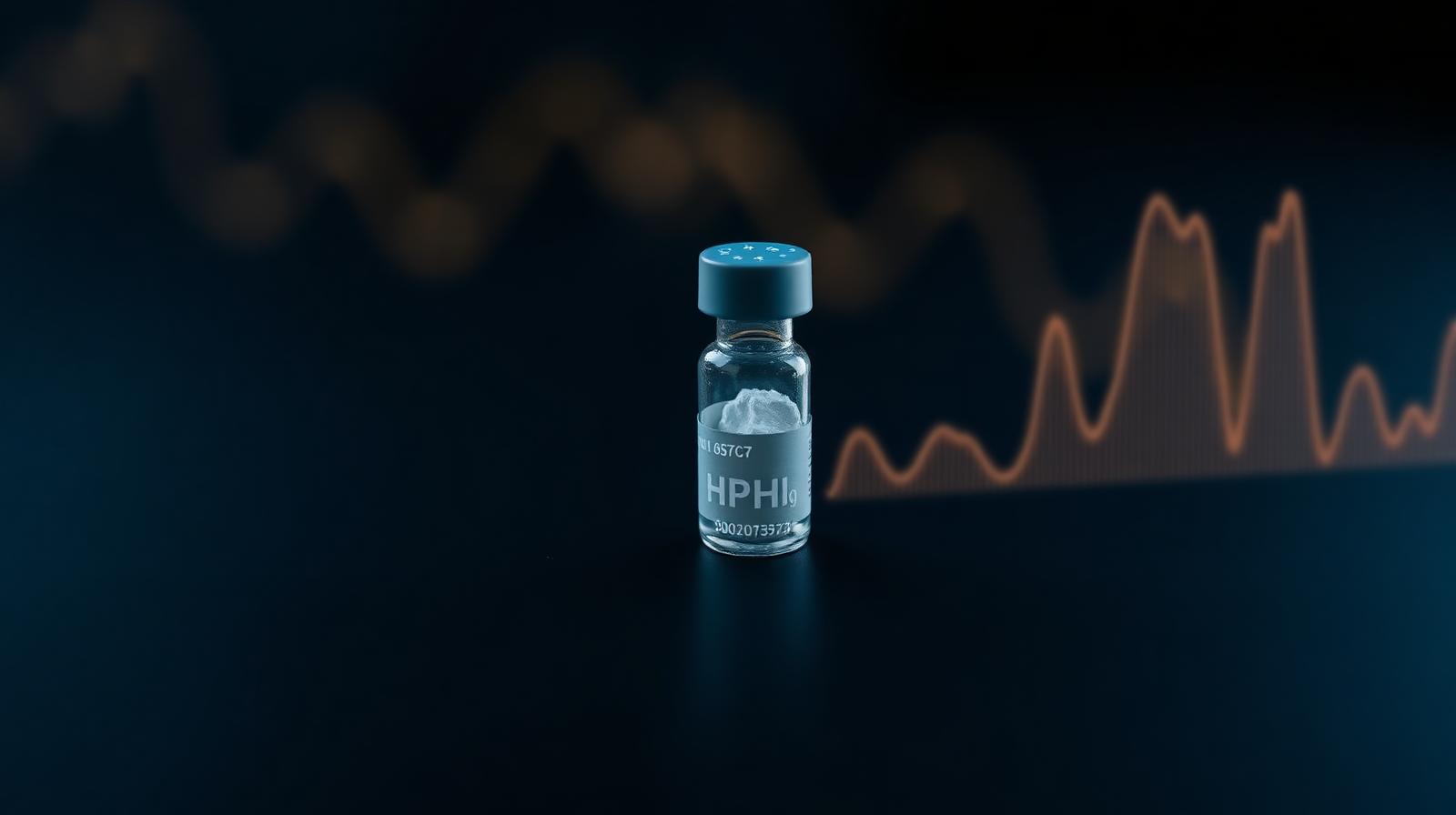
Reference vial CL-HGH-A1 — composited with the analytical chromatograms returned at release
Pricing guide · HGH (somatropin)
HGH peptide testing cost: how much it costs to test HGH (somatropin)
Recombinant HGH is a 191-residue folded protein, not a short synthetic peptide — so a credible third-party verification is a panel of orthogonal assays that together answer a different question than purity alone. This guide breaks down what each assay costs, what it actually measures, and which combination is appropriate for which buyer.
Contents
- 01The short answer
- 02Itemized cost table
- 03RP-HPLC purity — the floor, not the ceiling
- 04SEC dimer/aggregate — the assay HGH actually needs
- 05Identity — intact mass vs. peptide mapping
- 06Host-cell protein — the contamination buyers miss
- 07Recommended panels by use case
- 08What you actually receive for the price
- 09Why prices vary between labs
- 10Get an HGH batch verified
- 11Frequently asked questions about HGH testing cost
The short answer
A single-batch RP-HPLC purity test on recombinant HGH starts around $299. A complete identity-and-purity panel — RP-HPLC purity, intact-mass LC-HRMS, and SEC dimer/aggregate — runs $749 to $1,049 per batch. Adding tryptic peptide mapping for sequence confirmation brings it to roughly $1,149 to $1,499. Bacterial endotoxin (LAL/rFC) adds another $150 to $200, and host-cell protein ELISA adds $250 to $400.
Below we break down what each assay actually measures, why it is priced the way it is, and how to pick the smallest panel that answers your specific question. If you are buying rather than specifying methods, start with the HGH peptide testing buyer’s guide, which covers mail-in submission and how to read the report. CertikLabs publishes per-batch pricing at /pricing.
Itemized cost table
| Assay | What it answers | Typical price |
|---|---|---|
| RP-HPLC purity | % of material eluting as the somatropin main peak | $299 – $399 |
| Intact-mass LC-HRMS | Confirms the 22,125 Da somatropin mass within ppm tolerance | $249 – $349 |
| SEC dimer/aggregate | % monomer vs. dimer vs. higher-order aggregate | $199 – $299 |
| Tryptic peptide mapping | Sequence confirmation across all 191 residues | $399 – $549 |
| Host-cell protein (HCP) ELISA | ng of residual E. coli or mammalian-cell protein per mg of drug substance | $250 – $400 |
| Bacterial endotoxin (LAL/rFC) | EU per vial — lipopolysaccharide contamination | $150 – $200 |
| Residual host DNA (qPCR) | pg of host DNA per dose | $300 – $450 |
| Content (UV at 276 nm / BCA) | Actual mg of HGH per vial — not the label claim | $120 – $200 |
RP-HPLC purity — the floor, not the ceiling
Reverse-phase HPLC on a wide-pore C4 or C8 column with a water-acetonitrile gradient separates somatropin from common process- and degradation-related impurities: deamidated forms, oxidized methionines, clipped sequences, and residual purification reagents. A credible recombinant HGH batch should report ≥97% main-peak purity at 214 nm with the major related impurities itemized.
The critical limitation for HGH: RP-HPLC denatures the protein on column, so it cannot detect non-covalent dimers or higher-order aggregates — these elute as a single peak with the monomer. SEC (next section) is required to resolve the size-distribution question that purity alone cannot answer.
SEC dimer/aggregate — the assay HGH actually needs
Size-exclusion chromatography separates intact monomeric HGH (~22 kDa) from covalent and non-covalent dimers (~44 kDa) and higher-order aggregates. Under physiological-strength mobile phase, the protein stays folded and the assay reports the true size distribution as it exists in the vial. Release-grade material is typically ≥97% monomer, with the SEC chromatogram and the integrated peak table attached to the COA.
Aggregates matter because they correlate with reduced biological potency and increased immunogenicity risk in any in-vivo readout. A high-purity batch by RP-HPLC that is 90% monomer / 10% aggregate by SEC is not the same material as a high-purity batch that is 99% monomer — and the difference is invisible without SEC.
Identity — intact mass vs. peptide mapping
Intact-mass LC-HRMS measures the deconvoluted average mass of the folded protein and compares it to the theoretical 22,125 Da somatropin mass within instrument tolerance (typically ≤20 ppm on an Orbitrap or Q-TOF). It is fast, cheap, and confirms the molecule is the expected somatropin variant.
Tryptic peptide mapping digests the protein with trypsin, separates the resulting peptide fragments by LC, and identifies each fragment by MS/MS. Comparing the observed peptide map to the theoretical map confirms the actual amino-acid sequence across all 191 residues — including mass-degenerate substitutions (Leu↔Ile) that intact-mass alone cannot distinguish. For release-grade verification or any clinically critical batch, peptide mapping is the standard.
Host-cell protein — the contamination buyers miss
Residual host-cell proteins from the E. coli or mammalian expression host co-purify with HGH and are the dominant driver of immunogenicity in recombinant biologics. Industry release specifications target <100 ng HCP per mg of drug substance, measured by a process-specific ELISA validated against the expression host. HCP is rarely on vendor-issued COAs for grey-market HGH; its presence on an independent COA is a meaningful trust signal. Cost: $250 to $400 per sample.
Recommended panels by use case
- Fresh purchase from an unfamiliar vendor: RP-HPLC purity + intact-mass LC-HRMS + SEC dimer/aggregate. Total $749 to $1,049. Confirms the molecule is somatropin, quantifies main-peak purity, and rules out an aggregated batch.
- Quantitative reference material: Add content by UV276 or BCA. Total $869 to $1,249. You now also know how much HGH is actually in the vial.
- Sequence-confirmed release verification: Add tryptic peptide mapping. Total $1,149 to $1,499. Confirms all 191 residues, not just the mass.
- In-vivo or cell-culture use: Add HCP ELISA and bacterial endotoxin. Total $1,549 to $2,099. Required for any biological readout to be interpretable and immunogenicity-safe.
- Long-stored inventory: SEC dimer/aggregate + RP-HPLC, run as re-verification against original release values. Storage drives both aggregation and oxidation — see our stability primer.
- Auditing a vendor: Run any of the above as a blinded submission so the result cannot be reverse-engineered. See our blind testing protocol.
What you actually receive for the price
- A signed COA listing instrument, method, and measured values for each assay on the panel.
- Raw RP-HPLC and SEC chromatograms, deconvoluted intact-mass spectra, and the peptide-map fragment table as attachments — not just summary numbers.
- A unique public verification page at
/verify/CL-…with a scannable QR code that ties the COA to the specific vial. - A tamper-evident chain-of-custody record from receipt through analysis.
- Optional badge embed and integration-ready JSON for direct use on a vendor product page.
Why prices vary between labs
Three factors dominate price variation for the same HGH assay across labs: instrument grade (an Orbitrap intact-mass costs more than a single-quadrupole; both report "LC-MS identity"), method validation status (a validated, stability-indicating SEC method costs more than a generic gel-filtration run), and report depth (a one-page number-only PDF is cheaper than a full report with attached raw chromatograms and spectra). Comparing prices without comparing what the price buys is misleading.
As a buyer, the three questions worth asking any lab quoting HGH testing are: (1) Will the COA include raw RP-HPLC, SEC, and intact-mass data files? (2) Is the SEC method validated to resolve dimer from monomer at <1% accuracy? and (3) Is the peptide-mapping coverage at least 95% of the 191-residue sequence? A "yes" to all three is what a defensible HGH verification looks like.
Get an HGH batch verified
CertikLabs runs RP-HPLC purity, intact-mass LC-HRMS identity, SEC dimer/aggregate, tryptic peptide mapping, HCP ELISA, and bacterial endotoxin testing on customer-submitted HGH (somatropin) batches under chain of custody. Each verified batch publishes to a permanent /verify/CL-… page with the raw chromatograms and spectra attached. See /pricing for current per-batch rates and /sample-report for an example COA.
Frequently asked questions about HGH testing cost
How much does it cost to get HGH (somatropin) tested?
A single-batch RP-HPLC purity test on recombinant HGH starts at $299. A complete identity-and-purity panel — RP-HPLC purity, intact-mass LC-HRMS identity, and SEC dimer/monomer analysis — typically lands between $749 and $1,049 per batch. Adding tryptic peptide mapping for sequence confirmation brings the total to roughly $1,149 to $1,499. Bacterial endotoxin testing (LAL/rFC) adds another $150 to $200, and host-cell protein ELISA adds $250 to $400. Prices vary by lab and turnaround; CertikLabs publishes per-test pricing at /pricing.
Why does HGH testing cost more than short-peptide testing?
Somatropin is a 191-residue recombinant protein produced in E. coli or mammalian expression systems, not a 10-to-50-residue synthetic peptide. That changes the analytical question entirely. RP-HPLC alone cannot distinguish correctly folded monomer from dimer or aggregate, so size-exclusion chromatography (SEC) is required. Intact-mass measurement needs a high-resolution instrument (Orbitrap or Q-TOF) to resolve the 22,125 Da monoisotopic mass with the required ppm tolerance. Sequence confirmation by peptide mapping requires tryptic digest plus LC-MS/MS. Host-cell protein contamination from the expression host needs a process-specific ELISA. Each of these is a separate instrument and a separate method validation, which is why a complete HGH panel costs roughly two to three times a comparable short-peptide panel.
What is dimer/aggregate analysis and why does it matter for HGH?
Recombinant HGH self-associates under storage stress into covalent and non-covalent dimers, oligomers, and high-molecular-weight aggregates. These species are biologically distinct from the monomeric 22 kDa folded protein and are associated with reduced potency and increased immunogenicity risk. Size-exclusion chromatography (SEC) separates and quantifies monomer, dimer, and aggregate fractions in a single run. A credible HGH COA reports % monomer (typically ≥97% for release), % dimer, and % aggregate, with the SEC chromatogram attached. RP-HPLC purity by itself cannot detect aggregates because they co-elute with the monomer under reverse-phase conditions.
Do I need peptide mapping if intact-mass LC-HRMS already matched the theoretical mass?
Intact-mass LC-HRMS confirms that the measured average mass matches the theoretical 22,125 Da within instrument tolerance. It does not confirm the actual amino-acid sequence. A point mutation or single amino-acid substitution that preserves the mass within tolerance (e.g. Leu↔Ile, which is mass-identical) will pass intact-mass and fail peptide mapping. For a release-grade verification of a clinical or research-critical batch, peptide mapping is the standard for sequence confirmation. For a confirmatory check on already-characterized material, intact-mass alone is often sufficient and a cost-effective choice.
What is host-cell protein testing and when is it required?
Host-cell protein (HCP) is the residual mixture of E. coli or mammalian-cell proteins that co-purifies with the recombinant HGH. Industry release specifications typically require <100 ng HCP per mg of drug substance, measured by a process-specific ELISA. HCP matters because residual host protein is the dominant driver of immunogenicity in recombinant biologics. HCP testing is required for any HGH intended for in-vivo or clinical use; it is optional for purely analytical reference material. The test costs $250 to $400 per sample and requires a validated HCP ELISA kit matched to the expression host.
Can I send a blinded HGH sample?
Yes. A blinded submission withholds the labeled identity from the lab so the analysts characterize the material from scratch — they do not know it is supposed to be HGH. It is the strongest available evidence that the reported intact mass, peptide map, and SEC profile reflect the material in your specific vial, not a template result. Methodology and cost are the same as a labeled submission. CertikLabs accepts blinded and split-sample HGH submissions as a routine submission type. See our blind testing protocol for the full procedure.
What is the cheapest credible test for an HGH batch?
The cheapest credible single test for recombinant HGH is RP-HPLC purity combined with intact-mass LC-HRMS — typically $549 to $749 total. That combination confirms the material is somatropin by mass and quantifies the main-peak purity, but it does not detect dimer/aggregate (use SEC for that) and does not confirm sequence (use peptide mapping for that). For a fresh purchase from an unfamiliar vendor, the minimum defensible verification is RP-HPLC + intact-mass + SEC, which lands around $749 to $1,049 per batch.
How can I test whether my HGH is real?
Send a sample of the vial to an independent lab and ask for intact-mass identity by LC-HRMS plus RP-HPLC purity. LC-HRMS measures the actual molecular mass of what is in the vial and compares it against the 22,125 Da theoretical mass of 191aa somatropin; anything else — a shorter peptide, a different protein, or a blank vehicle — will not match. That two-assay check costs roughly $549 to $749 and is the cheapest defensible answer to 'is this real HGH?'. Adding SEC tells you whether the real HGH has aggregated in storage, and a blinded submission (you withhold the label) removes any possibility of a templated result.
How much does peptide testing cost compared with HGH testing?
A short synthetic peptide such as BPC-157 or semaglutide typically costs $199 to $499 per batch for identity plus purity, because a single RP-HPLC run and a single LC-MS run answer the question. Recombinant HGH costs roughly two to three times that — $749 to $1,499 depending on panel — because somatropin is a folded 191-residue protein that additionally requires SEC for dimer and aggregate content, peptide mapping for sequence confirmation, and often a host-cell protein ELISA for expression-host residue. The price difference is instrument time and method count, not markup.