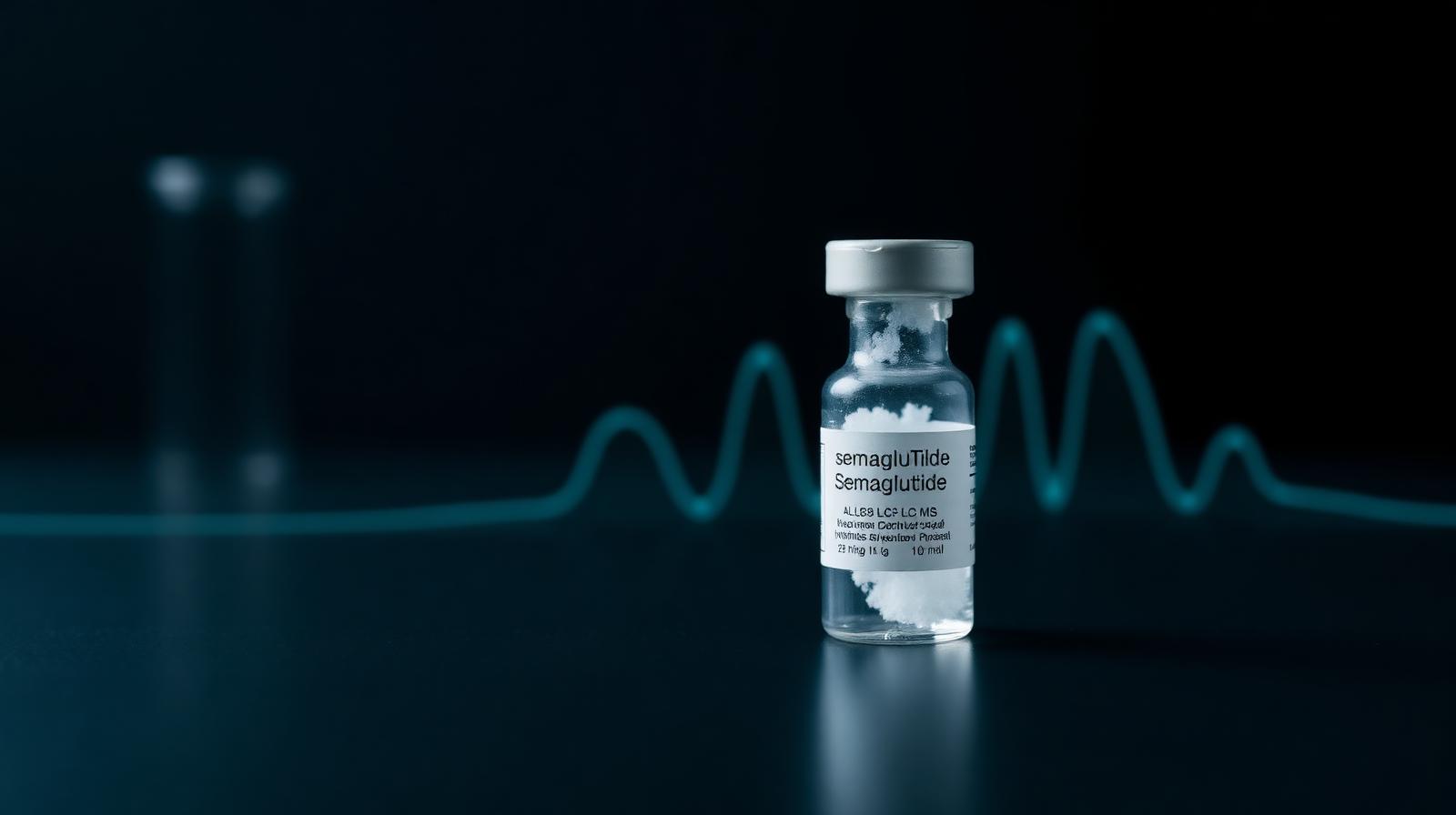
Reference vial CL-SEMA-A1 — composited with the deconvoluted LC-HRMS spectrum returned at release
Pricing guide · Semaglutide
Semaglutide testing cost: identity, purity, and content verification per batch
A credible third-party verification of semaglutide is not one test. It is a panel that has to confirm a fatty-acid side chain — not just a purity number on a generic gradient. This guide breaks down exactly what each assay costs and what each one actually measures.
Contents
The short answer
A single-batch HPLC purity test on semaglutide starts at $299. A complete characterization panel — HPLC purity, LC-HRMS identity with side-chain confirmation, and content by amino-acid analysis — runs $649 to $849 per batch. Adding bacterial endotoxin (LAL) brings it to roughly $849 to $1,049.
The price is set by the LC-HRMS step. Without high-resolution accurate mass, the test cannot reliably tell semaglutide apart from an unmodified GLP-1 backbone — which is the most common adulteration pattern on the gray market.
Itemized cost table
| Assay | What it answers | Typical price |
|---|---|---|
| HPLC purity | % of material eluting as the target peak | $299 – $349 |
| LC-HRMS identity (with side-chain) | Confirms intact mass and presence of C18 diacid + γ-Glu-(2xOEG) linker | $249 – $349 |
| Amino-acid analysis (content) | mg of peptide per vial | $149 – $249 |
| Tryptic peptide mapping | Sequence confirmation, side-chain attachment site | $250 – $350 |
| Bacterial endotoxin (LAL/rFC) | EU per vial | $150 – $200 |
| Sterility (USP <71>) | 14-day microbial growth (sterile-filtered material) | $200 – $350 |
| Residual TFA / counter-ion | Trifluoroacetate carried over from purification | $120 – $180 |
Why semaglutide identity is the expensive step
Semaglutide's monoisotopic mass is approximately 4111.1 Da (average ≈4113.6 Da). The structural distinction from native GLP-1(7-37) is the Aib substitution at position 2 and the C18 diacid + γ-Glu-(2xOEG) side chain at Lys-26. HPLC retention time alone does not reliably resolve semaglutide from an unmodified GLP-1 analog at similar concentration. LC-HRMS with deconvolution to the monoisotopic envelope is the assay that confirms both the intact mass and the presence of the side chain at the expected position.
A credible semaglutide COA shows the deconvoluted spectrum, the observed mass within <10 ppm of theoretical, and ideally an MS/MS fragment confirming the Lys-26 attachment site.
Content — how much peptide is in the vial
Amino-acid analysis after acid hydrolysis is the standard credible content method for semaglutide. It distinguishes the mass of peptide from the mass of counter-ion, water of crystallization, and bulking agent. For a labeled 5 mg vial, AAA is the only standard method that confirms the vial actually contains 5 mg of semaglutide rather than 3 mg of peptide and 2 mg of mannitol or salt.
Recommended panels by use case
- Receiving a fresh purchase: HPLC purity + LC-HRMS identity. Total $549 to $699.
- Quantitative reference material: Add amino-acid analysis. Total $649 to $849.
- Side-chain confirmation: Add tryptic peptide mapping. Total $899 to $1,149 — required when defending a release decision against the possibility of unmodified-GLP-1 adulteration.
- Auditing a vendor: Run any of the above as a blinded submission. See our blind testing protocol.
What CertikLabs does and does not do
CertikLabs is an analytical chemistry verification service. We report what the molecule is, how pure it is, how much is in the vial, and whether it is contaminated with endotoxin or microbes. We do not prescribe, advise on dosing, certify a product as fit for human use, or comment on the legal or regulatory status of compounded semaglutide. The chemistry data is the deliverable.
Get a semaglutide batch verified
CertikLabs runs HPLC purity, LC-HRMS identity with side-chain confirmation, amino-acid analysis content, and endotoxin testing on customer-submitted semaglutide batches under chain of custody. Each verified batch publishes to a permanent /verify/CL-… page. See /pricing for per-batch rates and /peptides/semaglutide for the full chemistry profile.
Frequently asked questions about semaglutide testing cost
How much does it cost to get semaglutide tested?
A single-batch HPLC purity test on semaglutide starts at $299. A complete characterization panel — HPLC purity, LC-HRMS identity, and content by amino-acid analysis — typically runs $649 to $849 per batch. Adding bacterial endotoxin (LAL) brings the total to roughly $849 to $1,049. Identity is priced higher than a generic short peptide because the C18 diacid fatty-acid side chain has to be confirmed by accurate mass, not just nominal mass.
Why does identity testing matter more for semaglutide than for a plain peptide?
Semaglutide is a modified GLP-1 analog: an Aib substitution at position 2 and a C18 diacid fatty-acid chain attached through a γ-Glu-(2xOEG) linker at Lys-26. Counterfeit or impure material on the market is often unmodified GLP-1 sequence, missing the side chain entirely. HPLC alone cannot reliably tell them apart. LC-HRMS with deconvolution to the monoisotopic mass (≈4113.6 Da) is the only credible way to confirm that the molecule is semaglutide and not a cheaper analog.
Can a generic peptide lab actually verify semaglutide?
Only if the lab has a validated method specifically for the semaglutide side-chain identity confirmation. Many peptide labs run a generic C18 gradient and report a purity number without confirming the fatty-acid side chain is intact. Buyers should ask explicitly whether the LC-MS method confirms the C18 diacid + γ-Glu-(2xOEG) linker, and request the deconvoluted mass spectrum in the COA.
What is the cheapest credible test for semaglutide?
HPLC purity at $299 to $349 with an attached chromatogram. It is necessary but not sufficient — it will not confirm the molecule is semaglutide rather than unmodified GLP-1. A combined HPLC + LC-HRMS identity panel at $549 to $649 is the smallest credible test that distinguishes semaglutide from common adulterants.
Does CertikLabs test compounded semaglutide products?
CertikLabs performs chemistry-only analytical verification on submitted samples. We do not certify a product as fit for human use, prescribe, or comment on the clinical or regulatory status of compounded semaglutide. We report what the molecule is, how pure it is, and how much is in the vial — and we publish those results on a permanent verification page.